In the Greater Peoria area, a growing number of seniors are turning retirement into a launchpad—not a finish line.
On a breezy Saturday morning along the Peoria RiverFront Market, Jim is already on his third sale of the day. A young couple lingers over a set of handcrafted wooden cutting boards, running their fingers along the smooth grain. Jim smiles, offering a quick story about the walnut tree the wood came from—storm-felled just outside of Metamora a few years back.
“Every piece has a past,” he says. “I just help give it a future.”
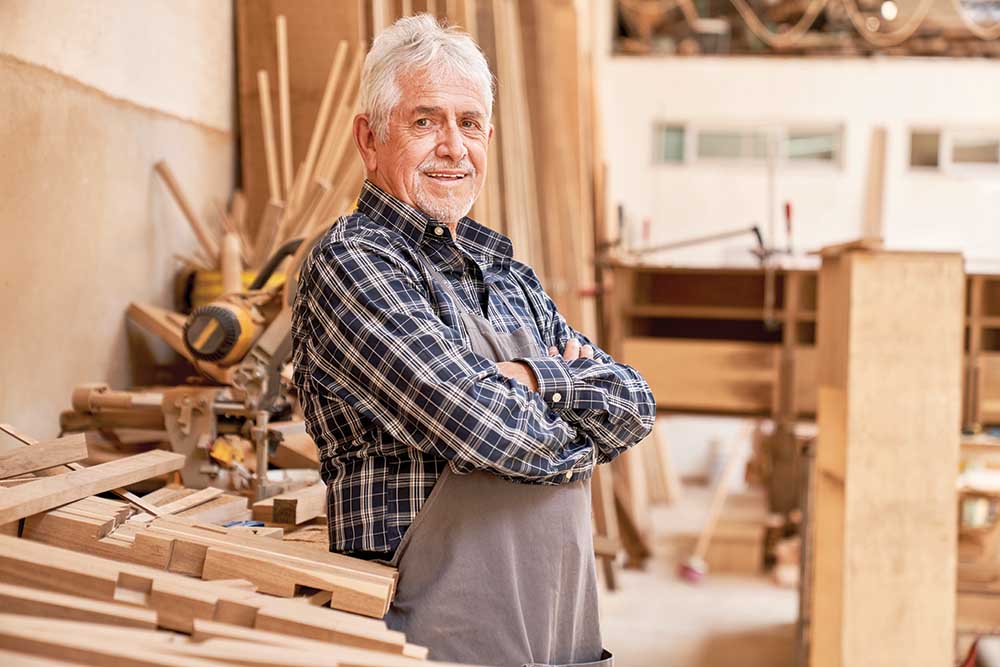
Five years ago, Jim wasn’t thinking about farmers markets, custom orders, or brand names. He was a maintenance supervisor, counting down the months to retirement. Today, at 72, he’s the owner (though he’ll laugh if you call him that) of a small but steadily growing woodworking business that keeps his hands busy and his calendar fuller than he ever expected.
And he’s far from alone.
A Different Kind of Retirement
For many in central Illinois, retirement used to follow a familiar script: slow down, enjoy more free time, maybe travel a bit, and settle into a quieter routine. But that picture is shifting.
Across the Greater Peoria area—from Washington to Canton to Morton—more seniors are finding themselves pulled toward something new after they leave their full-time careers. Sometimes it’s about extra income. More often, it’s about something harder to define: purpose, connection, or finally having the time to try something they’ve put off for decades.
“I thought I’d be bored,” Jim admits. “And I was—for about two months.”
That’s when he wandered into his garage, dusted off a set of old tools, and started experimenting. One project turned into ten. Friends started asking for pieces. Then strangers. Before long, someone suggested he try selling at a local market.
“I figured, why not?” he says. “Worst case, I’d have a story to tell.”
From Career to Craft
Jim’s path into woodworking wasn’t entirely new—he’d always enjoyed tinkering—but turning it into something public felt different.
“The first time someone handed me money for something I made, it felt strange,” he says. “But also kind of validating.”
Now, his weeks have a rhythm: a few mornings in the workshop, an afternoon delivering an order, Saturdays at the market when the weather cooperates. He’s not chasing growth or trying to scale up. In fact, he turns down work when things get too busy.
“That’s the beauty of starting something at this stage,” he says. “You get to decide what it looks like.”
More than the income—which he describes as “nice, but not the point”—Jim values the conversations.
“You meet people you never would’ve met otherwise,” he says. “That’s been the best part.”
Quick Takes: Other Second Acts Around Town
Jim’s story is just one version of a growing local trend. Here are a few others finding their own rhythm in retirement:
Linda, 68 – Pekin
Then: Elementary school teacher for 30 years
Now: Baking custom cakes and pastries from her home kitchen
“I spent my life making cupcakes for other people’s celebrations,” Linda says. “Now it’s kind of come full circle.”
What started as baking for family birthdays has turned into a steady stream of orders—weddings, graduations, and everything in between. “I don’t take as many orders as I could,” she says. “I take as many as I want.”
Bob, 74 – East Peoria
Then: Engineer
Now: Volunteer bike repairer and neighborhood handyman
Bob doesn’t charge for most of what he does, but that hasn’t stopped demand. His garage is a revolving door of bikes needing tune-ups and small household fixes.
“I like solving problems,” he says. “That didn’t stop just because I retired.”
Marsha, 66 – Washington
Then: Office administrator
Now: Running a small online shop selling handmade quilts
Marsha taught herself how to sell online with help from her granddaughter. “There was definitely a learning curve,” she laughs. “I didn’t even know how to upload a picture at first.”
Now she ships quilts across the country—and keeps a map marking where each one ends up.
Why It Works
Talk to enough people like Jim, Linda, Bob, and Marsha, and a few common threads start to emerge.
First, there’s the freedom. Without the pressure of building a full-time income, many seniors feel more comfortable experimenting.
“You’re not risking everything,” Jim says. “You’re just trying something.”
There’s also the social side. What begins as a solo hobby often turns into a way to reconnect with others—customers, neighbors, even other vendors.
And then there’s something deeper: a sense of identity that doesn’t disappear when a career ends.
“For a long time, when people asked what I did, I had one answer,” Jim says. “Now it’s different. And honestly, that feels pretty good.”
The Challenges No One Talks About
Of course, starting something new later in life isn’t without its hurdles.
Technology can be a sticking point. Marsha recalls feeling overwhelmed at first trying to set up her online shop. “There were moments I thought, maybe this just isn’t for me,” she says.
Physical limitations can also play a role. Jim has learned to pace himself in the workshop, taking more breaks than he used to.
“I can’t do eight-hour days out there anymore,” he says. “But I don’t need to.”
Then there’s the mental hurdle—the quiet but persistent question: Is it too late to start something new?
For most, the answer comes through action, not reflection.
“You don’t really get past that fear until you try,” Linda says. “And then you realize it wasn’t as big as it felt.”
Thinking About Your Own Second Act?
If these stories spark an idea—or even just a curiosity—you’re not alone. Many who’ve started something new in retirement say the hardest part was simply beginning.
A few pieces of advice come up again and again:
- Start small. You don’t need a full plan—just a first step.
- Follow your interest, not the market. If you enjoy it, you’re more likely to stick with it.
- Ask for help. Whether it’s technology, setup, or ideas, someone around you likely knows more than you think.
- Keep it flexible. The goal isn’t to recreate a full-time job—it’s to build something that fits your life now.
- Let it evolve. What starts as a hobby may grow—or it may stay small. Both are fine.
Full Circle
Back at the RiverFront, Jim wraps up another sale, carefully placing a cutting board into a paper bag. The customer thanks him, then pauses.
“Did you always do this?” she asks. Jim smiles, shaking his head.
“No,” he says. “This is the new chapter.”
As the crowd shifts and the morning moves on, he leans back for a moment, taking it all in—the conversations, the steady hum of the market, the quiet satisfaction of building something from scratch, later in life than he ever imagined.
“I thought retirement was going to be about slowing down,” he says. “Turns out, it was just about changing direction.”
And for Jim—and many others across the Greater Peoria area—that new direction is turning out to be exactly what they didn’t know they were looking for.