By Alexander Germanis
We tend to think that once we hit a certain age we stop growing. While that may be true in terms of things like height, we are capable of growing as long as we live. We can grow intellectually, emotionally, and spiritually. We can also grow in experience and in our interests. We continue to grow in countless ways.
Cities and communities experience growth in multiple ways as well; and with growth comes expanding need and, unfortunately, some growing pains. Graceland Center for Purposeful Aging has been experiencing growth, as has the senior community in general. Both, therefore, need help from the greater community of Peoria to continue forward.
On the Move
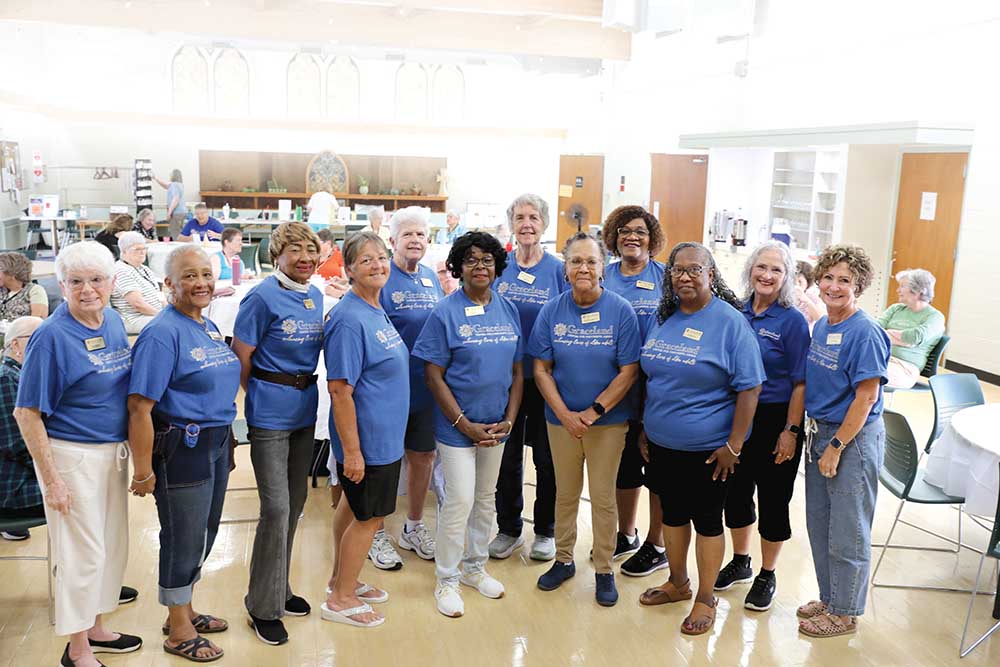
Just as a family that adds a few more kids might need to relocate to a larger home, Graceland Center needed more space to accommodate their increasing number of participants. Moving to Westminster Community Center also gives them a larger fellowship hall, more space for art, classes, games, a library, and is better for serving meals in their congregate meal program. Plus, it stays centrally located for ease of access from all areas of the Peoria.
According to Graceland Center’s Founder and Executive Director Peggy Jacques, the Westminster Community Center’s proximity to Bradley University also factored in the move, “to involve more students to volunteer or do learning rotations with our participants,” she says. “We have already had Bradley BSN students rotate through with us for their community health rotation and business students who did their senior capstone project with us. We would also like to coordinate with the Osher Lifelong Learning Institute (OLLI) in encouraging our participants to participate their programs.”
To help people get used to the new location, Graceland and Westminster added four FUN Fridays to their programming where people could take tours and learn of the potential for the new facility.
Of course, no growth is without the aforementioned pains. Graceland has experienced that due to the omnipresent bane of living in the Midwest: roadwork. “Our biggest challenge has been the construction on MacArthur Highway and on the streets around Bradley University,” Peggy admits. “Once the construction is finished and people can get a straight pathway on Moss Avenue, I think getting to Westminster will be much easier and less intimidating to our participants.”
Why a Senior Center?
Ranked eighth in size of the 20 largest cities in Illinois, Peoria is the only one without a wellness-based center for older adults. Grant funding for these centers comprises less than 3% of total available grants. Both in Illinois and on a national scale, most centers are funded with a combination of private and public funding. Without some form of public funding Graceland Center will find it difficult to maintain its current level of programming or growth. The senior population in all communities is growing, as is the need to promote healthy aging.
Peggy says there are three interrelated obstacles to these areas of growth: lack of awareness of what a senior community center is, financial stability, and not understanding the social detriments of health.
“To live is to age – that is an undeniable fact of life,” Peggy says. “To live well, we must care for our mental, physical, financial, and emotional well-being. And as a community, we must be accountable to those who need support. The older generation in Peoria built the foundation we stand on today. How are we honoring that legacy? Right now, the answer is: not well enough.”
Cities around Peoria have enjoyed senior wellness centers for decades and yet Peoria lags behind largely due to not really knowing what such a center is. “A modern senior center is a hub of vitality, purpose, and community connection,” Peggy explains. “Once people understand the value such a center can provide not only to participants, but to their families, extended family, friends, and the general community through improved wellness, the demand for services will help stimulate funding through donations and sponsorships, and this will assist with the financial sustainability.”
“Most cities established their centers during a time when funding was more accessible and they have had time to develop deep roots of funding through endowments, government contracts, and audits, making them eligible for larger grants,” she continues.
The third obstacle is a lack of understanding of what social isolation does. “Social isolation, difficulty accessing resources, and changes in people’s social networks following retirement can have detrimental effects on the health of older adults, and cause strain within the family unit,” Peggy says. “When the imperative of how vital connections are for older adults to thrive and have purpose is understood, the support will flow.” Being able to age in place and be healthy increases an adult’s health span – the years without debilitation, saves them money, prevents overtaxing the health care system, and helps families not be so stressed in providing care support. “Altogether,” Peggy adds, “these add enjoyment and fulfillment in our later years.”
Making the Center a Reality
Starting with meetings in April and May and a resolution to form a Senior Services Ad Hoc Committee in July, the need to ensure Peoria has a wellness-based center for older adults has been brought to the forefront for elected officials. “This is a golden opportunity to transform a long-ignored issue into a model of community success,” Peggy says. “Township governance explicitly recognizes the needs of senior citizens and provides the mechanism to study these solutions. Our hope is that this committee will return a clear, actionable plan for Peoria!”
Peggy says there are numerous ways the public of Peoria can support this movement. People can donate to support their expenses (a link can be found on the website), consider a legacy gift from wills or trusts, consider underwriting programs, communicate with elected representatives on the need for the center, and spread the knowledge of what benefits a center can provide. People can also donate time and talents in workshop spaces, volunteer for programs, help serve meals, clean up, participate in community events to promote Graceland Center programs, and more. Donations to this 501c3 organization are tax-deductible to the extent allowed by tax laws.
Peggy adds one more way the public can help: “Insist Peoria be designated an ‘Age Friendly’ community as defined by the AARP – where older adults are celebrated, included, and have resources to help them age in place.”
Growth of Interaction
One important lesson learned during the government-forced shutdowns of COVID was the negative impact that reduced social interactions can make. Perhaps no one experienced this worse than our senior populations. Fortunately, places like Graceland Center have placed enormous focus on social interaction and its astounding power to change, brighten, and enhance life.
As some renovation projects at the Westminster Community Center are completed, more areas like the library, art room, and game room will become available for socializing. “Several people are already meeting up to go on different outings on their own,” Peggy points out, with a hope for them to coordinate more social outings that are off-site in the community, such as going to a play, movie, dinner, and more.
“We are planning to do an AARP-sponsored intergenerational mural in September entitled ‘Celebrate Generations, Peoria’ as a way to communicate the importance of intergenerational relationships,” she says. “I think the need for friendship is so underestimated. And the impact of getting out of their homes; meeting and interacting with others; and using social skills to interact and discuss the past, their families, their friends, their joys, and worries, is tremendous.”
Peggy concludes, “Having a center with their concerns as its mission gives respect and dignity to people who otherwise feel like they may not be an important part of their communities. Our goal at Graceland Center is to be a place that celebrates life with grace and dignity for older adults.”
As Graceland Center continues to grow in size, its ambition and goals for the future also continue to grow. But all growth requires nourishment. That nourishment needs to come from a city that not only recognizes its senior population is important to the greater community but is also of growing value.
Graceland Center for Purposeful Aging is located at 1504 West Moss Avenue in Peoria, Illinois. To learn more about it or to find the link to donate to the cause of a senior wellness community center in Peoria, please visit www.gracelandcenter.com.
Or call 833-503-7773 to find out how else you can help.