By Janie Beharelle, 50 Plus N&V Reader
This is not my love story, however, it is as touching and powerful as the popular Hollywood movie entitled, “The Notebook.” This is a true-life drama about a couple going through their journey with Alzheimer’s disease. As a nurse who cared for Esther while she was at our long-term care facility, I watched the unconditional love of a husband carry both of them through this devastating disease.
The day that a co-worker and I screened this family for a placement at our facility, I knew that they were a very special couple. As we asked Lee, her husband, questions about Esther’s behavior and health issues, she clung tightly to his arm, seldom looking our way. As he began to explain that he could no longer physically care for her, tears rolled gently down his cheeks. I could tell it was probably the most difficult decision he had ever made. Lee was physically and emotionally exhausted from caring for his lifelong companion and partner. For her safety and his health she was soon to be admitted to our facility.
Lee and his wife had raised three dedicated and successful children. They were as loving and caring as their parents. One of their sons was a dentist and the other son was an executive at a major manufacturing company. Their daughter taught music at a local college. One request that they were really adamant about was letting Esther have access to a piano. She had been a beautiful pianist throughout her life, and somehow Alzheimer’s disease had not robbed her of her talent for playing the piano.
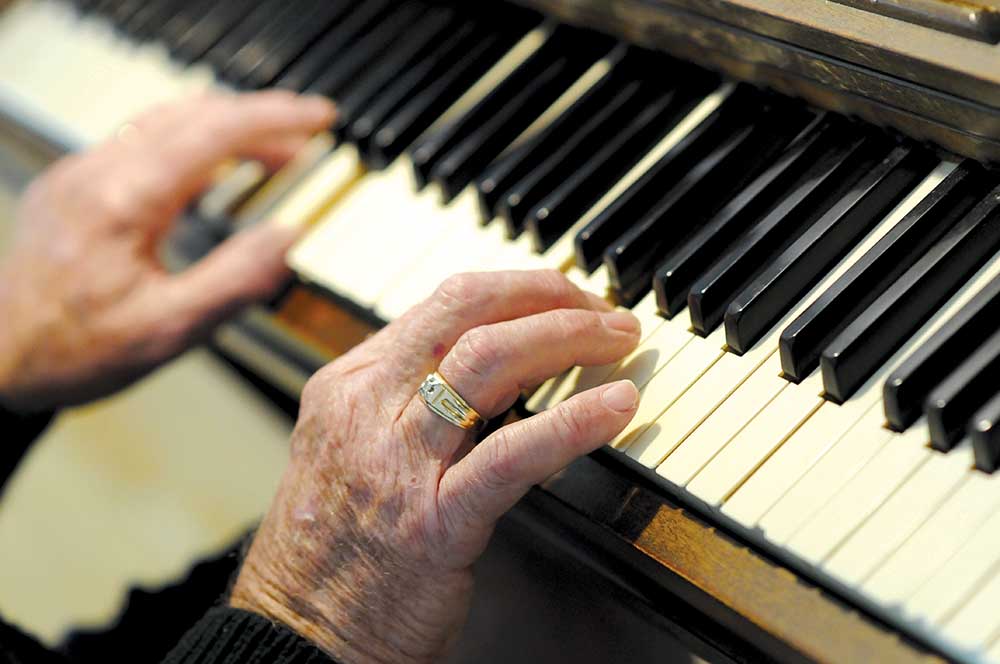
A short time after she was admitted, we were able to place a small organ in our “Special Care Unit.” It had been donated to our nursing home, and this was the perfect spot since Esther could still play beautifully. Because an organ and piano are so similar, she was able at anytime to sit down and play almost any tune without the need for sheet music. The melody and harmonies that she had played over the years seemed to be still locked within her memory bank and she would step to the organ and reel off song after song. Her superb talent delighted the other residents and several of the ladies would twirl around by themselves as she played music from their era. Lee would smile brightly when he visited, as he saw his beloved partner doing what had been her signature in life…playing music for others.
While other aspects of his wife’s health were physically and mentally diminishing, her one constant of playing that organ never wavered. She played so many songs from the 40s and 50s and did it by memory. Most of the residents in the Special Care Unit recognized these songs, and some would sing along. Esther helped entertain her peers despite her dementia.
As time went by, Esther played less and less, but she seemed to still recognize that organ and towards the end of her life would still go up to it and play a few notes on the black and white keys that had been such a big part of what defined her. Like the thread of an old quilt that is broken in places but still keeps the material together, people with Alzheimer’s disease often retain one passion that was their signature in life. Lee provided that when he asked us to make that musical instrument available to his wife.
Lee and his children visited as often as they could. Esther and Lee would often just sit and hold hands as the silence seemed to be more comforting than the pain that Alzheimer’s disease often exhibits when the words no longer come to the person with the disease. All of Esther’s siblings (four sisters and one brother) had endured her same journey and died of Alzheimer’s disease.
As her disease progressed, Esther no longer recognized eating utensils. She would eat her food with her hands rather than a spoon or fork. Esther often used a waste basket instead of the toilet. Alzheimer’s disease can strip away your dignity in so many ways. After twenty years working with dementia patients, it seems like nothing surprised me. It is one of the cruelest diseases because it takes away so much of who you are as a person.
Over the many months that Esther was in our facility, her disease progressed, and she was able to do less and less for herself. She roamed the halls, always hunting for her Lee, her husband. She would yell out his name as she passed by each room. Thus, she was so delighted when he came and they would sit together for hours simply holding hands in the comfort of each other.
I was Esther’s nurse the day she was admitted and I was by her side the day she took her last breath. Lee, his children, and I waited as she made the transition from life to death. Her last moments of life were actually very peaceful, and for that, I was very grateful for Lee and his children. Her journey with Alzheimer’s was finally over. What I will remember most about her is not only her talent and love of music, but the unconditional love of a husband who endured the journey by her side every step of the way.
Their life was not played out on the big screen as in “The Notebook,” however, this real-life love story was just as touching to me. In my fifty-five years as a nurse, I have never seen such a dedicated and loving person as Lee. Unfortunately, he had to travel the path on Esther’s journey with Alzheimer’s. However, he stood next to her through good and bad and endured that very painful experience as her soul mate.
Several years after Esther died, Lee was admitted to our long-term care facility. He did not have Alzheimer’s but did have other serious health issues. He died after a short stay in another unit at the nursing home. The greatest love story I have witnessed is not one I have read in a book or seen on the Hollywood movie screen. It is the true life love story of Esther and Lee, a couple enduring one of the most difficult journeys in life together.